

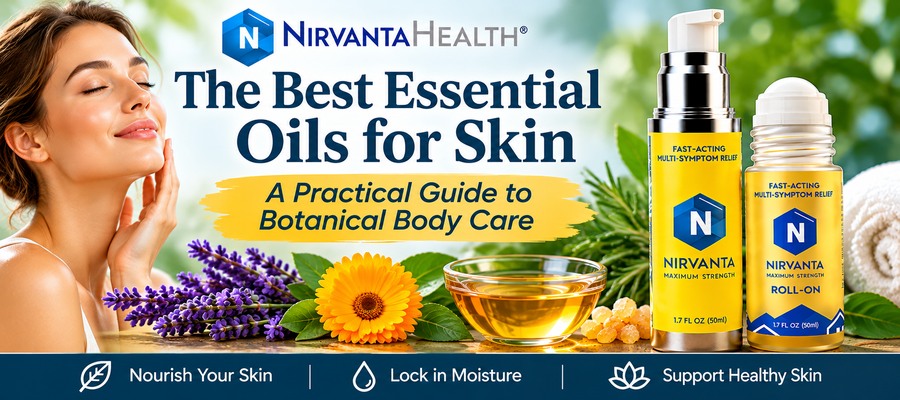
Discover how essential oils, nourishing botanical carrier oils, and thoughtfully formulated blends fit into everyday body care.
For centuries, people have incorporated oils from flowers, seeds, fruits, and aromatic plants into personal-care routines. Today, botanical skincare appeals to people seeking naturally derived ingredients, distinctive fragrances, and skin-conditioning products. But should you use lavender or frankincense? Is jojoba an essential oil? What makes helichrysum interesting? And do you really need to purchase and mix multiple oils?
For shoppers who love the idea of botanical body care but don't want to buy and mix a collection of individual oils, there's another option: Nirvanta Maximum Strength brings aromatic essential oils and skin-conditioning botanicals together in a convenient, physician-formulated topical body oil. Explore Nirvanta Maximum Strength as you learn what makes the ingredients in a well-designed blend worth considering.
Essential Oils vs. Carrier Oils: What's the Difference?
Essential oils are concentrated aromatic substances obtained from plants. Carrier oils (also called fixed oils) generally come from seeds, nuts, or fruits and contain fatty acids and related ingredients that help condition and soften skin. Essential oils should not be confused with carrier oils, and many concentrated essential oils require dilution before skin application.
| Essential oils | Botanical carrier oils |
|---|---|
| Lavender | Sweet almond |
| Frankincense | Jojoba (technically a liquid wax) |
| Helichrysum | Apricot kernel |
| Cedarwood | Sunflower seed |
| Lemongrass | Rosehip seed |
Both categories can contribute to a finished body-care formulation, but they perform different roles. Essential oils often provide fragrance and aromatic complexity; carrier oils provide emollient properties, spreadability, and skin feel. Natural ingredients are not automatically safe for everyone: essential oils can irritate skin or cause allergic contact dermatitis.
For a deeper look at why these ingredients play different roles in a finished formulation, read our essential oils vs. carrier oils guide.
Seven Botanical Oils Worth Knowing About
1. Frankincense Oil: An Ancient Aromatic Botanical
Frankincense comes from trees of the Boswellia genus. Its warm, resinous aroma makes it a recognizable ingredient in botanical blends. Research on concentrated Boswellia resin extracts is not interchangeable with research on distilled frankincense essential oil. For everyday cosmetic use, frankincense is best understood as a distinctive aromatic botanical rather than a proven treatment for a skin condition.
Interested in its history? Read our frankincense and Boswellia research guide, which discusses the limitations of the evidence.
2. Lavender Oil: A Familiar Skincare Essential Oil
Lavender is widely used in aromatic body oils and personal care. Its floral fragrance helps create a recognizable botanical experience. Some studies have explored individual lavender constituents, but these results do not establish clinical effects for every lavender-containing product. Oxidized fragrance components may trigger allergic contact dermatitis in susceptible people.
3. Helichrysum Oil: The Botanical Known as Immortelle
Helichrysum, including Helichrysum italicum, has a long history in aromatic personal care. It is sometimes marketed with extensive therapeutic promises, yet much of the research is preliminary or laboratory-based. In a skincare blend, its distinguishing characteristic is its aromatic contribution.
4. Jojoba: A Different Kind of Botanical Oil
Although commonly called jojoba oil, jojoba is technically a liquid wax. It is widely used for conditioning skin and improving the feel of cosmetic formulas. A 2024 experiment using cultured human skin tissue reported changes in certain measurements associated with hyaluronic acid and procollagen. This is interesting ingredient-level research, not proof that any particular consumer product has the same effect.
5. Rosehip Seed Oil: Naturally Occurring Fatty Acids
Rosehip seed oil contains fatty acids and is used as an emollient in skincare. Researchers have investigated rosehip preparations for cosmetic appearance and other applications, but strong clinical evidence remains limited for many widely advertised benefits.
6. Sunflower Seed Oil: Skin-Conditioning Support
Sunflower seed oil contains fatty acids, including linoleic acid. In a small human study, topical sunflower seed oil preserved skin-barrier integrity and improved hydration under the conditions tested. Its effects in a finished product depend on the oil, concentration, overall formulation, and person using it.
7. Calendula: Botanical Skincare Tradition
Calendula (pot marigold) appears in many botanical skincare formulas. A small human study using a particular calendula cream reported improved measured hydration and firmness. That study cannot establish the same results for every calendula extract or product.
Why Combine Essential Oils and Carrier Oils?
A carefully designed formulation can combine the aromatic qualities of essential oils with the conditioning and emollient roles of carrier oils. Aromatic oils such as lavender, frankincense, and helichrysum can sit alongside skin-conditioning ingredients such as jojoba, sweet almond, sunflower, and apricot kernel oils. Additional ingredients, including vitamin E, may support the stability or feel of a formula.
More oils do not automatically make a formula better. What matters is the selection of compatible ingredients, their concentrations, the finished product's stability, and skin tolerance.
DIY Essential Oil Blends vs. Ready-to-Use Botanical Products
For people who enjoy blending oils, DIY skincare can be rewarding. It also requires attention to ingredient compatibility, dilution, storage, and consistency. A ready-to-use product offers an alternative for people who prefer not to purchase multiple bottles or calculate their own mixtures.
| Buying and blending individual oils | Choosing a finished botanical blend |
|---|---|
| Purchase separate ingredients | Purchase one formulated product |
| Research dilutions and compatibility | Follow product-specific usage instructions |
| Measure and mix at home | No home mixing required |
| Manage multiple bottles | Convenient ready-to-use packaging |
| Choose every ingredient yourself | Choose a pre-established combination |
Curious whether a finished botanical oil is more convenient than making one yourself? Explore our comparison of professionally formulated botanical oil blends and DIY mixing.
Meet Nirvanta Maximum Strength: Botanical Everyday Body Care
At Nirvanta Health, we focus on bringing botanical ingredients together into a convenient finished formulation. Nirvanta Maximum Strength is a physician-formulated topical body oil combining aromatic essential oils, skin-conditioning botanical oils, and proprietary Nirvanta Oil technology.
Its botanical ingredient story includes lavender, frankincense, helichrysum, jojoba, sunflower seed, sweet almond, apricot kernel, and rosehip seed oils. The formula is intended for convenient targeted application as part of an everyday body-care routine. For full ingredient information, refer to the product's current label.
Explore Nirvanta Maximum Strength Pump or learn about Nirvanta Maximum Strength Roll-On.
How to Choose Botanical Oils for Your Skin
- Identify the type: Is it a concentrated essential oil, a carrier oil, or a finished blend?
- Understand its purpose: Look for realistic cosmetic roles such as fragrance and skin conditioning.
- Read the full ingredient list: This matters especially if you have allergies or fragrance sensitivities.
- Consider the whole formulation: Concentration, compatibility, and stability are as important as featured ingredients.
- Follow safety directions: Avoid undiluted essential oils on skin unless product-specific directions establish an appropriate use. Keep oils away from your eyes and discontinue use if irritation occurs.
Frequently Asked Questions
Are essential oils good for your skin?
They may contribute fragrance or other formulation characteristics, but suitability varies by oil, concentration, formulation, and individual sensitivity.
Can you apply essential oils directly to your skin?
Most concentrated essential oils should be appropriately diluted before topical use. Even diluted oils can cause irritation in some individuals.
Is jojoba an essential oil?
No. Jojoba is a liquid wax generally grouped with carrier oils in skincare.
Which botanical oils are useful for dry-feeling skin?
Carrier oils such as sunflower, sweet almond, jojoba, and apricot kernel are commonly used in emollient cosmetic formulations.
Are expensive essential oils necessarily better?
No. Price reflects sourcing, availability, extraction yields, and many other factors, not guaranteed skincare effectiveness.
Do blends work better than individual oils?
Not automatically. A blend can combine complementary characteristics, but results depend on the entire formulation.
The Bottom Line
Botanical body care is about more than fragrance. Knowing the difference between essential oils and skin-conditioning carrier oils helps you choose products suited to your routine. For people who appreciate botanicals but prefer a ready-to-use product, Nirvanta Maximum Strength offers a convenient alternative to purchasing and blending multiple oils at home.
Discover Nirvanta Maximum Strength
Scientific References and Further Reading
- Danby SG et al. Effect of olive and sunflower seed oil on the adult skin barrier. Pediatric Dermatology (2013). PubMed.
- Calendula extract research on human skin hydration and firmness. PubMed.
- DermNet. Allergic contact dermatitis to essential oils.
- U.S. FDA. Aromatherapy.
Research on isolated ingredients, extracts, or experimental formulations does not establish clinical effectiveness of Nirvanta Maximum Strength. This article is educational and is not medical advice.


