

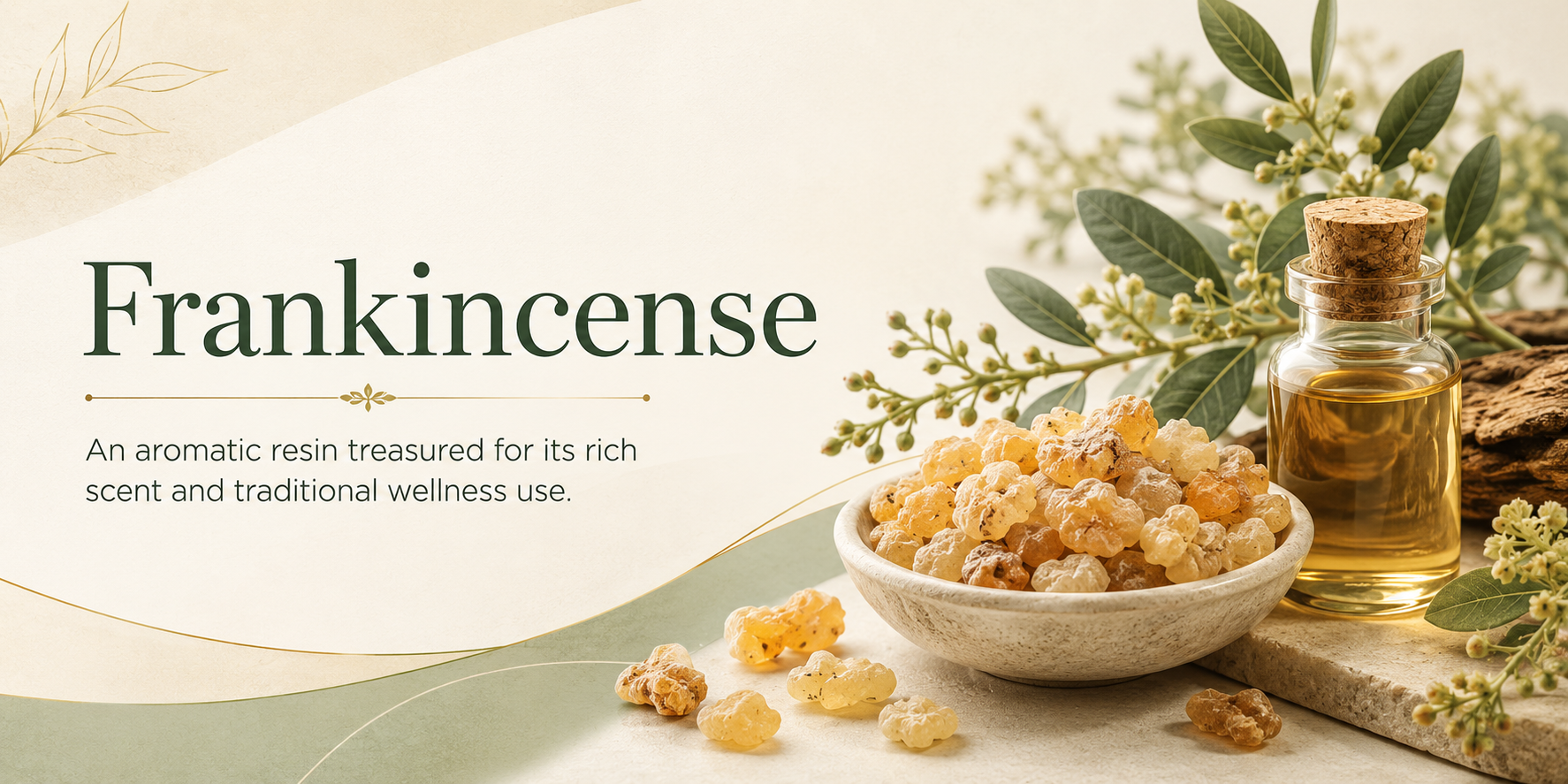
What Is Frankincense? Exploring Boswellia, Joint Health Research, and Botanical Oils
Frankincense has been valued for thousands of years. From ancient trade routes to modern botanical formulations, this aromatic resin has a fascinating history.
Today, scientists are studying compounds found in frankincense and their potential relationships with inflammation, joint health, and other biological processes.
But what does the research actually tell us? And what's the difference between frankincense essential oil and the Boswellia extracts used in scientific studies?
Let's explore the science behind this remarkable botanical ingredient.
What Is Frankincense?
Frankincense is an aromatic resin harvested from trees belonging to the Boswellia genus. These trees grow in parts of Africa, the Arabian Peninsula, and India.
For centuries, frankincense has been used in incense, fragrance, traditional wellness practices, and botanical preparations.
One particularly well-studied species is Boswellia serrata, often called Indian frankincense.
Researchers have investigated this species because its resin contains naturally occurring compounds that may influence biological pathways associated with inflammation.
However, not all frankincense preparations contain the same compounds, and the results of research on one preparation cannot automatically be applied to another.
Frankincense Essential Oil vs. Boswellia Resin Extract
Understanding the difference between these two preparations is essential.
Frankincense Essential Oil
Frankincense essential oil is generally obtained through steam distillation of Boswellia resin.
The resulting oil contains volatile aromatic compounds, including various terpenes. Its composition varies depending on the Boswellia species, growing conditions, and production method.
These aromatic components contribute to the oil's distinctive fragrance and have attracted interest from scientists studying botanical chemistry.
Frankincense essential oil is commonly incorporated into personal-care products and botanical oil formulations.
Boswellia Resin Extract
Boswellia resin extracts are produced using different extraction methods and can contain compounds known as boswellic acids.
Boswellic acids are nonvolatile compounds that are generally absent from conventional steam-distilled frankincense essential oils.
This distinction matters because much of the human clinical research involving Boswellia and osteoarthritis has focused on standardized oral resin extracts rather than essential oils.
The takeaway: Research findings involving oral Boswellia supplements should not automatically be interpreted as evidence that topical frankincense essential oil produces the same effects.
What Does Scientific Research Say About Boswellia and Joint Health?
Researchers have investigated Boswellia extracts for their potential effects on osteoarthritis symptoms.
Some small clinical studies have reported improvements in pain or physical function among participants taking particular oral Boswellia extracts.
However, results vary, studies have important limitations, and larger, higher-quality clinical trials are needed.
The National Institutes of Health's National Center for Complementary and Integrative Health notes that there is insufficient high-quality evidence to determine whether Boswellia is useful for treating any health condition.
Evidence concerning topical applications is even more limited.
These findings make Boswellia an interesting subject for ongoing scientific investigation, but they do not establish that every frankincense-containing product will produce the same results.
Why Are Scientists Interested in Frankincense Compounds?
Scientists study botanical ingredients partly because plants produce numerous chemically distinct substances.
Frankincense contains different classes of compounds depending on how it is prepared.
Some experimental studies have examined relationships between these compounds and biological signaling pathways associated with inflammation.
These include pathways involving enzymes and signaling proteins such as:
-
Cyclooxygenase enzymes, including COX-2.
-
Nuclear factor kappa B (NF-κB).
-
Inflammatory signaling molecules, including certain cytokines.
These pathways play important roles in the body's biological responses.
However, laboratory findings do not necessarily predict what happens when an ingredient is applied to human skin, and they cannot establish the clinical effectiveness of a finished topical product.
Further research is necessary to understand how particular compounds behave in specific formulations and under real-world conditions.
Frankincense in Botanical Body Care
Beyond its scientific interest, frankincense essential oil has a long history of use in aromatic and personal-care preparations.
It is frequently blended with carrier oils and other botanical ingredients.
In topical products, the complete formulation matters. Different carrier oils, ingredient concentrations, and preparation methods can influence a product's characteristics and how it feels during application.
For consumers interested in botanical personal care, several practical considerations are worth keeping in mind.
Ingredient Transparency
Look for products that clearly identify their ingredients and provide useful application instructions.
Formulation Quality
A thoughtfully designed product should consider ingredient compatibility, consistency, skin tolerance, and intended use.
Application Experience
Texture, fragrance, ease of application, and how the product feels on the skin are important aspects of everyday body care.
Skin Sensitivity
Essential oils can cause irritation or allergic reactions in some individuals. Follow product directions and discontinue use if irritation develops.
How Nirvanta Approaches Botanical Topical Oils
At Nirvanta Health, we're interested in the science of plant-derived ingredients and the development of thoughtfully formulated topical products.
Our Nirvanta Maximum Strength topical oil incorporates our proprietary Nirvanta Oil alongside a botanical formulation designed for everyday body-care routines.
Rather than relying on a single botanical ingredient, our formulation reflects our broader approach to product development.
We are also committed to scientific investigation of our proprietary technology, with research activities examining biological responses associated with our formulations.
It is important to distinguish early-stage laboratory findings from demonstrated clinical outcomes. Research findings should be understood within the limits of the specific experiments performed.
Explore Nirvanta Maximum Strength to learn more about our topical oil, ingredients, and suggested use.
Frequently Asked Questions
Is frankincense the same as Boswellia?
Frankincense is the aromatic resin obtained from trees in the Boswellia genus. Different Boswellia species produce resins with different chemical profiles.
Does frankincense essential oil contain boswellic acids?
Conventional steam-distilled frankincense essential oil generally does not contain the boswellic acids found in certain resin extracts.
Has Boswellia been studied for joint health?
Yes. Researchers have studied particular Boswellia resin extracts, including oral preparations in people with osteoarthritis. Some results are encouraging, but the evidence remains limited and does not establish the effectiveness of topical essential oils.
Can frankincense essential oil be used in body-care products?
Yes. Frankincense essential oil is an ingredient in various topical personal-care preparations. Products should be formulated appropriately and used according to their directions.
Is botanical always the same as safe?
No. Plant-derived ingredients can cause irritation, allergic reactions, or other unwanted effects. Safety depends on the ingredient, concentration, formulation, and individual circumstances.
The Bottom Line
Frankincense brings together centuries of botanical history and an evolving body of scientific research.
Researchers continue to explore the chemical compounds found in Boswellia and their potential biological properties.
The most important lesson is that different forms of frankincense are not interchangeable. Evidence involving one extract, ingredient, or experimental preparation should not be treated as proof about another.
At Nirvanta Health, we believe botanical innovation and responsible scientific investigation belong together.
This article is for educational purposes and does not provide medical advice. Consult an appropriate healthcare professional about persistent joint symptoms or questions involving medical treatment. The research discussed does not establish that Nirvanta Maximum Strength treats any disease or medical condition.


