

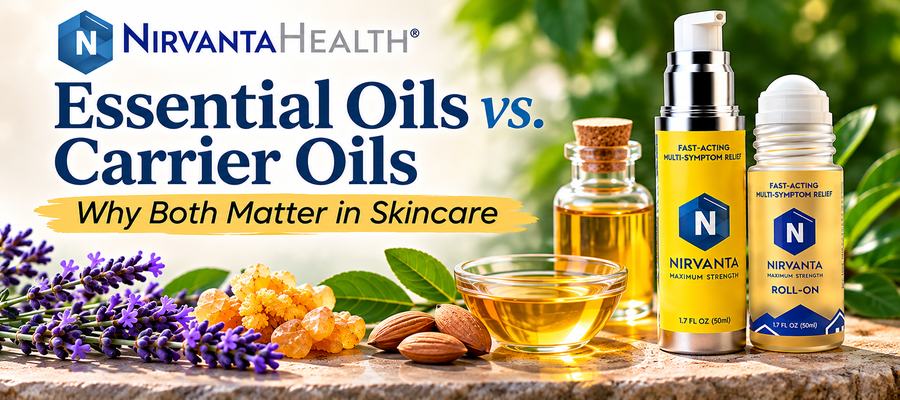
Essential oils and carrier oils are often mentioned together, but they aren't interchangeable. One category delivers concentrated aromatic plant compounds; the other provides the fatty-acid-rich base that helps a topical formula glide across skin and feel comfortable. Understanding both makes it much easier to choose botanical body-care products.
For people who appreciate essential oils but would rather skip buying, measuring, and mixing several bottles, Nirvanta Maximum Strength offers a convenient alternative. Its physician-formulated topical body oil brings recognizable aromatic oils together with complementary skin-conditioning botanicals in a ready-to-use product. Explore Nirvanta Maximum Strength while learning why the two types of oils work so well in a thoughtfully designed formula.
Our perspective at Nirvanta Health: We specialize in bringing essential oils, carrier oils, and plant-based formulation science together. We believe true expertise in botanical body care means understanding not only what each ingredient is, but also how ingredients work together in a thoughtfully designed finished product. This guide is part of our commitment to making that knowledge accessible to everyone interested in botanical skincare.
What Is an Essential Oil?
Essential oils are concentrated, aromatic materials derived from botanical sources, often through distillation or other extraction methods. Their characteristic scents come from mixtures of volatile compounds that differ by plant species, growing conditions, and processing. A few familiar examples are lavender, frankincense, cedarwood, and helichrysum.
Because essential oils are concentrated, they are generally added to topical body-care products in small amounts. Their presence does not automatically make a product better, safer, or more effective. Identity, quality, concentration, and the complete formulation all matter.
What Is a Carrier Oil?
Carrier oils, also called fixed oils, are generally obtained from seeds, nuts, or fruits. Unlike aromatic essential oils, they usually contain nonvolatile lipids, including fatty acids, which contribute to emollience, spreadability, and the way a formula feels on skin.
Examples include sweet almond, apricot kernel, sunflower seed, and rosehip seed oils. Jojoba is commonly grouped with carrier oils, although chemically it is a liquid wax. A carrier oil is not merely an inactive filler: its composition can influence texture, skin conditioning, product stability, and the overall experience of application.
Essential Oils vs. Carrier Oils: The Key Differences
| Feature | Essential oils | Carrier oils |
|---|---|---|
| Typical origin | Aromatic plant materials | Seeds, nuts, fruits, or botanical waxes |
| Typical composition | Concentrated volatile aromatic compounds | Fatty acids, triglycerides, wax esters, and related lipids |
| Common role in body care | Aroma and specialized formulation characteristics | Skin conditioning, emollience, and spreadability |
| Use on skin | Usually appropriately diluted | Frequently used as a substantial part of the base |
| Examples | Lavender, frankincense, helichrysum | Sweet almond, sunflower, jojoba |
A product may use both categories because they contribute different characteristics. The ideal balance depends on the intended use and the skin tolerance of the person applying it.
Why Carrier Oils Matter in Botanical Skincare
1. They help create a pleasant skin feel
Choosing the right carrier oils influences whether a body oil feels heavy, light, silky, or slow to absorb. Different botanical oils have different lipid profiles, so a blend can be formulated for a particular texture rather than relying on a single ingredient.
2. They contribute skin-conditioning lipids
Plant oils can act as emollients, helping skin feel softer and smoother. Human research has examined sunflower seed oil, for example, in relation to skin hydration and barrier integrity. But results from one studied oil or formulation cannot simply be attributed to every finished product that contains it.
3. They help distribute concentrated aromatic ingredients
Carrier oils provide a practical vehicle for diluted essential oils. The Tisserand Institute explains that dilution is an important part of managing skin-reaction risk when using concentrated essential oils. Suitable concentration depends on the oil, intended use, and the person applying it.
Which Oils Does Nirvanta Combine?
Nirvanta Maximum Strength's botanical formulation includes both aromatic essential oils and skin-conditioning carrier oils. Examples from its ingredient list include:
| Ingredient category | Examples in Nirvanta | Primary cosmetic role |
|---|---|---|
| Aromatic essential oils | Lavender, frankincense, cedarwood, helichrysum, lemongrass | Aromatic character and botanical complexity |
| Carrier oils and botanical lipids | Sweet almond, apricot kernel, sunflower seed, rosehip seed, jojoba | Emollience, skin feel, and spreadability |
| Additional botanical ingredients | Calendula, sea buckthorn, vitamin E | Skin conditioning or supporting formulation roles, depending on the ingredient preparation |
Not every botanical ingredient in a formula is an essential oil. Calendula, for example, is often supplied as an infused preparation, while jojoba is a liquid wax. That distinction matters when evaluating ingredient claims. For the complete current ingredient declaration, consult the product label.
Why a Ready-to-Use Botanical Blend May Make More Sense Than DIY
Creating your own essential-oil body blend can be enjoyable. But it also involves selecting the correct oils, measuring concentrations, considering sensitivities, and storing ingredients appropriately. Buying multiple bottles can add cost and complexity, even before you begin blending.
A finished topical oil simplifies the process. With Nirvanta Maximum Strength, the ingredients have already been combined into a consistent product; you don't need to become a home formulator to enjoy a multi-botanical body-care routine.
See the Nirvanta Maximum Strength Roll-On for precise, convenient targeted application, or explore the Pump for everyday use.
One point worth emphasizing: a longer ingredient list alone does not prove that a product is safer or more effective. The value of a finished blend depends on formulation quality, appropriate ingredient levels, compatibility, and the user experience.
What About Dilution and Essential-Oil Safety?
Undiluted essential oils can cause irritation or allergic reactions. Organizations such as the National Association for Holistic Aromatherapy and Tisserand Institute recommend appropriate dilution and care with skin application. Some aromatic ingredients can also oxidize during storage, affecting skin tolerance.
- Follow the instructions on the finished product rather than applying a homemade dilution formula to a commercial blend.
- Do not apply essential oils to open wounds, damaged skin, or near the eyes.
- Stop using any product that causes irritation.
- Review the full ingredient list if you have known botanical, nut, or fragrance sensitivities.
- Seek qualified advice before use in special circumstances such as pregnancy, use on young children, or significant skin sensitivity.
Natural sourcing and premium quality do not eliminate the possibility of an allergic reaction.
Frequently Asked Questions
Is a carrier oil the same as an essential oil?
No. Essential oils are concentrated aromatic materials, while carrier oils are generally lipid-rich botanical oils used for skin conditioning and as a base for diluted aromatic ingredients.
Can you use carrier oils by themselves?
Many carrier oils are used on their own for cosmetic skin conditioning, although suitability varies with allergies, skin type, and product quality.
Does adding more essential oil make a blend stronger or better?
Not necessarily. Greater essential-oil concentration may increase irritation risk without providing a corresponding improvement in the desired cosmetic experience.
Is jojoba an essential oil or a carrier oil?
Jojoba is a liquid wax generally grouped with carrier oils because of its cosmetic role and feel.
Why do finished botanical products contain multiple oils?
Different oils can contribute complementary characteristics such as aroma, softness, texture, and spreadability. The whole formulation matters more than the ingredient count.
The Bottom Line: Two Types of Oils, One Thoughtful Formulation
Essential oils and carrier oils bring different qualities to botanical skincare. Essential oils provide concentrated aromatic character; carrier oils contribute skin-conditioning lipids and the base that makes a topical product practical to use. When carefully formulated together, they can create a convenient everyday body-care experience.
If you enjoy botanical ingredients but don't want to purchase and mix multiple individual oils, discover Nirvanta Maximum Strength and explore a ready-to-use approach to botanical body care.
For more botanical skincare education, explore our companion guides: The Best Essential Oils for Skin and Why a Professionally Formulated Botanical Oil Blend May Be Better Than DIY Mixing.
References and Further Reading
- National Association for Holistic Aromatherapy. Methods of Application.
- National Association for Holistic Aromatherapy. Essential Oil Safety.
- Tisserand Institute. Dilution for Essential Oils.
- Tisserand Institute. Safety Guidelines.
- Danby SG et al. Effect of olive and sunflower seed oil on the adult skin barrier: implications for neonatal skin care. Pediatric Dermatology (2013). PubMed.
Research on individual oils does not establish clinical effectiveness for Nirvanta Maximum Strength. This article is intended for cosmetic and body-care education and is not medical advice.


